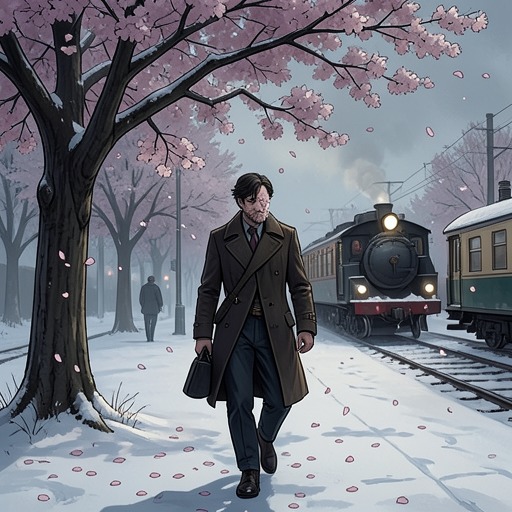
“I’ll give you a blessing”
5 Centimeters per Second“I’ll give you a blessing” is Shun’s farewell to Asuna Watase, a brief expression whose meaning unfolds after she first hears it. He explains it through the one thing he wants for her: that she live. Asuna does not fully grasp the words in the moment, but remembers them later and asks her mother what a blessing means. The answer turns Shun’s phrase into an affirmation of existence, while the story’s later confrontation with death and resurrection gives that affirmation added weight.
The Farewell and Its Uncomprehended Meaning
As Shun and Asuna Watase speak, she says she will leave once the cicadas stop crying. The scene places Shun at the end of his life, and he thinks that, if nothing else, he has to make sure to do this. He calls her name and says, “I’ll give you a blessing.” The declaration arrives without explanation, so Asuna is confused by its suddenness rather than prepared to understand its importance.
Shun asks Asuna Watase to close her eyes, then gently kisses her forehead. Startled, she opens them and struggles to ask what he has done. Her shock interrupts any immediate response to his words. Shun calls her name again and clarifies the wish behind the blessing: “All I want is for you to live.” The phrase is therefore not a prediction or a promise that hardship will spare her. It is Shun’s stated desire for her continued life, spoken at what he understands to be his own end.
That gap between what Shun means and what Asuna can absorb gives the expression its delayed force. At first, the blessing is an unfamiliar phrase attached to an unexpected farewell. Its meaning is not settled by Shun’s explanation alone; Asuna must return to it later, after she has had time to hear it as something more than a puzzling remark.
Asuna Watase Learns What a Blessing Means
Shun’s words recur in Asuna Watase’s mind after the events in Agartha. One night, she asks her mother what a blessing is. Her mother answers that it means being glad someone was born, adding that she is glad of Asuna’s birth too. Asuna nods, and memories with her mother rise in response.
The exchange gives Shun’s phrase a second, intimate context. His wish that Asuna live is not treated merely as an instruction to survive; her mother’s explanation connects blessing to welcome and gratitude for her existence. The phrase thus moves from Shun’s personal farewell into a wider affirmation that Asuna’s life matters to the people who love her. Her memories do not erase the sorrow surrounding Shun’s absence, but they place his words within a continuing network of care.
The order matters. Asuna does not understand the blessing when Shun first offers it, and she does not receive its fuller meaning through another dramatic declaration. Instead, she asks an ordinary question at home. Her mother’s answer allows the remembered phrase to become legible: what Shun wanted was not simply that Asuna obey him, but that she continue to exist and live among those who are glad she was born.
Resurrection, Loss, and the Value of Life
The story places this affirmation beside a stark account of resurrection’s cost. When Nami explains that bringing her back required Eve’s life, Ryuuji Morisaki asks whether that is why Eve is absent. Nami confirms it: “The price for bringing me back was Eve. A life for a life.” This exchange does not directly explain Shun’s blessing, but it sharpens the moral problem against which the phrase can be read. In a world where the attempt to reverse one death has cost another life, a wish that someone live cannot be separated from the consequences of refusing to accept loss.
The parallel becomes especially strong in the final confrontation at the Gate of Life and Death. After the attempt to resurrect Lisa, Ryuuji Morisaki collapses emotionally and begs Shin to kill him. Shin refuses, saying that his brother spoke to him: “He said to embrace loss—to keep on living.” Asuna Watase opens her eyes and embraces Ryuuji Morisaki. The scene does not repeat Shun’s exact blessing, but it returns to its central insistence: life must continue even when the dead cannot simply be restored.
Shun’s wish and Shin’s reported message are distinct utterances, spoken in different circumstances. Their shared emphasis on living nevertheless makes the earlier blessing resonate beyond Asuna Watase’s private memory. The phrase first names what Shun wants for her; the final scene gives that wish a broader ethical counterpart, as the surviving characters face grief without turning it into a demand for another death.
The Expression’s Role in the Story
The blessing’s significance lies partly in its delayed comprehension. Asuna Watase is too startled to understand Shun’s words when he says them, and the narrative returns to the phrase later, when she asks her mother for its meaning. This recurrence changes the expression from an enigmatic farewell into a form of reassurance grounded in birth, attachment, and the desire that another person remain alive.
It also marks a contrast between remembering the dead and trying to undo death. Shun’s blessing does not promise that Asuna Watase will be spared grief, and the story does not present it as a means to restore those who have died. Instead, its meaning accords with the later instruction to embrace loss and keep living. The words preserve a bond with Shun without making that bond dependent on bringing him back.
As a result, “I’ll give you a blessing” functions both as a personal parting gift and as a concise statement of the story’s response to mortality. Its tenderness comes from the specificity of Shun’s wish for Asuna Watase; its lasting importance comes from the way that wish is reinterpreted through her mother’s answer and echoed, in altered form, at the Gate of Life and Death.